
 Mitochondrial Health Decline
Let’s talk about something that doesn’t get enough attention in mainstream weight loss conversations: mitochondrial health. Mitochondria are tiny powerhouses inside your cells that are responsible for creating energy.
But as we age—or when we’re under stress, toxic burden, inflammation, or poor nutrition—our mitochondria can begin to slow down. Some stop functioning altogether. And when your mitochondria are tired, so are you. You feel sluggish, foggy, achy and inflamed. You crave sugar and caffeine. You can’t exercise like you used to. Your body starts storing fat, even though you’re “doing everything right.” Supporting mitochondrial health may be one of the most overlooked yet essential steps in improving energy, metabolism, and sustainable weight loss.
According to researchers, mitochondrial dysfunction is now recognised as a major contributor to metabolic disease and obesity. This 2022 review in Biomedicines explains how impaired mitochondrial energy production alters insulin signalling, increases fat storage, and lowers fat oxidation.
Why Mitochondria Matter
Every cell in your body—except red blood cells—contains mitochondria. They convert nutrients into ATP (energy). Without enough energy, your cells can’t detox, repair, communicate, or regulate hormones properly. When mitochondrial health declines, your body struggles to manage energy efficiently, which can lead to a cascade of symptoms, such as:
- Sluggish metabolism
- Fatigue
- Increased fat storage
- Inflammation
- Insulin resistance
Dr. Joseph Mercola has written extensively about mitochondrial health. In his article “Mitochondria: The Key to Slowing Aging and Improving Energy”, he highlights how environmental toxins, poor sleep, EMF exposure, and processed foods all damage mitochondrial function.
What’s fascinating is that studies now show obese individuals have fewer and less efficient mitochondria than lean individuals. Their cells simply don’t burn energy as effectively. This study from Frontiers in Endocrinology shows how mitochondrial impairment affects muscle mass and metabolic flexibility.
What Damages Mitochondria?
One of the biggest threats to mitochondrial health today is the sheer volume of chemicals and low-nutrient food we’re exposed to daily. These include:
- Environmental toxins (pesticides, mould, heavy metals)
- Processed foods and refined sugar
- Chronic stress and cortisol dysregulation
- Sleep deprivation
- Sedentary lifestyle
- Nutrient deficiencies (especially magnesium, B vitamins, CoQ10, carnitine)
- Overuse of pharmaceuticals
Even things like plastic exposure and blue light at night can interfere with mitochondrial repair cycles.
Dr. Terry Wahls—a clinical professor and MS survivor—has also documented how repairing mitochondria helped her reverse her symptoms and get out of a wheelchair. Her Wahls Protocol focuses heavily on mitochondrial nutrition.
How to Reignite Your Cellular Power
Recent research also shows great promise in supplements that support mitochondrial repair and energy metabolism by boosting levels of NAD+ (Nicotinamide Adenine Dinucleotide), a molecule essential for energy transfer in cells. NAD+ levels naturally decline with age, which may contribute to fatigue, metabolic decline, and increased fat storage.
Among the most promising precursors to NAD+ is NMNH (Reduced Nicotinamide Mononucleotide), a newer form that may be even more bioavailable than NMN. This 2023 study published in Nature Metabolism suggests NMNH may improve NAD+ levels more efficiently and support cellular metabolism.
Another helpful compound is Resveratrol, a polyphenol found in red grapes and berries. It has been shown to activate SIRT1, a longevity gene that plays a role in mitochondrial function and fat metabolism. A clinical trial in Obesity found that resveratrol supplementation mimicked some effects of calorie restriction, enhancing energy efficiency and mitochondrial density.
Dr. Mercola discusses the synergy between NAD+, NMN, and resveratrol in his article “NAD and Resveratrol – Keys to Reversing Cellular Aging”, where he outlines how combining these nutrients may help regenerate mitochondrial function, especially in aging or metabolically challenged individuals.
That said, not everyone responds to supplements in the same way, so it’s best to consult with a healthcare provider before starting any new regimen. You don’t need to take extreme measures to begin supporting your mitochondrial health. Small, consistent actions can have a massive impact over time.
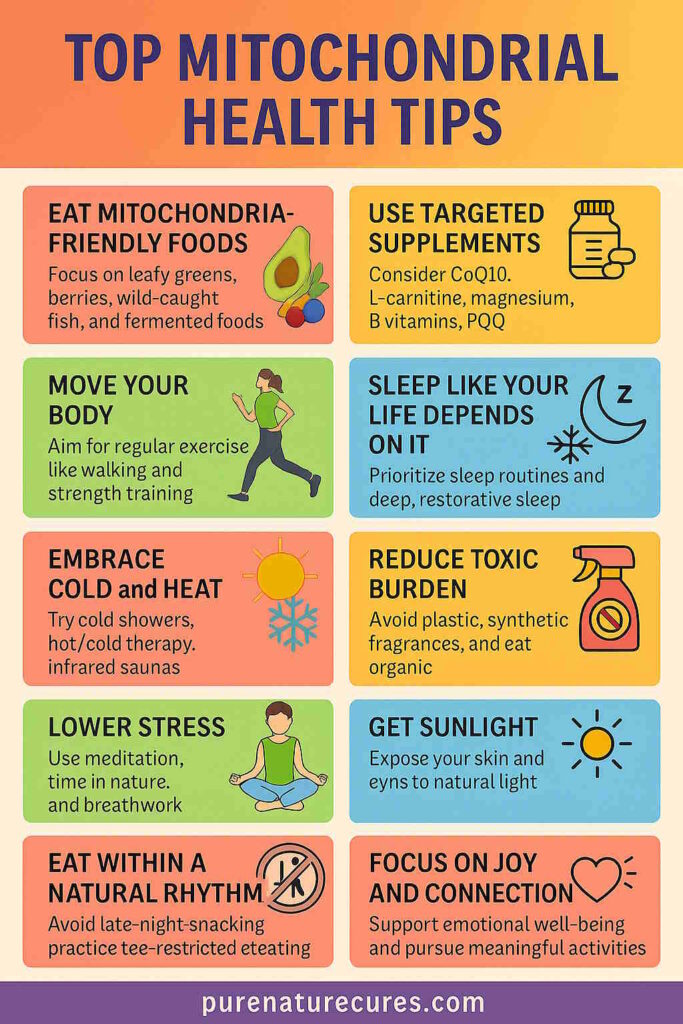
- Eat mitochondria-friendly foods
Leafy greens, brightly coloured vegetables, wild-caught fish, grass-fed meat, berries, avocado, raw cacao, fermented foods. Prioritise nutrient density over calorie-counting. - Use targeted supplementation
Work with a practitioner to assess needs. Common mitochondrial supports include:
- CoQ10 or ubiquinol
- Magnesium
- L-carnitine
- Alpha-lipoic acid (ALA)
- PQQ (Pyrroloquinoline quinone)
- B-complex vitamins
These nutrients work synergistically to restore mitochondrial health and enhance the body’s ability to convert food into energy.
- Move your body gently but consistently
Exercise boosts biogenesis (the creation of new mitochondria). Walking, resistance training, and burst training all help. - Embrace cold and heat
Cold showers, infrared saunas, and hot/cold contrast therapy stimulate mitochondrial resilience. - Sleep like your life depends on it
Because it does. Mitochondria repair during deep sleep. Prioritise winding down, darkness, and sleep routines. - Reduce toxic burden
Limit plastic, avoid synthetic fragrances, and eat organic where possible. Support gentle detox through sweating, hydration, and fibre-rich foods. - Lower stress
Meditation, time in nature, breathwork, therapy—whatever works for you. Chronic stress depletes mitochondrial function. - Get sunlight on your skin and eyes
Sunlight in the morning boosts circadian rhythms and mitochondrial efficiency. Dr. Jack Kruse discusses this in great detail. - Eat within a natural rhythm
Avoid late-night snacking. Time-restricted eating helps mitochondrial health and repair. - Focus on joy, connection, and purpose
Believe it or not, mitochondrial health is tied to emotional wellbeing. Positive states help cells thrive.
Final Thoughts
If you’ve been doing “all the right things” and still can’t lose weight or feel energised, it may be time to zoom in on your cellular energy. This isn’t about adding one more thing to your to-do list. It’s about gently creating the right conditions for your cells—and your body—to come back into balance. By choosing foods, habits, and routines that support mitochondrial health, you’re giving your body the energy and resilience it needs to heal from the inside out.
In the next post, we’ll explore the role of toxic overload and how our modern environment may be pushing the body to store fat as a protective mechanism. Until then, honour your energy. Your mitochondria are listening.
If you’d like to go deeper and explore natural methods for supporting mitochondrial health, detoxification, and weight loss, my Far Infrared Mineral Weight Loss Course offers a practical, evidence-informed approach. It’s ideal for both individuals and professionals, with online modules and an optional in-person practical session in the UK.

